- English
- 中文版


.jpg?height=93&quality=100)
Over the past week, gold held in a consolidation range following a bounce from the $4,500–$4,510 area. April's nonfarm payrolls beat headline expectations but contained enough under-the-hood weakness to fall short of providing the clear directional signal markets were looking for. Meanwhile, the U.S.-Iran talks hit another wall over the weekend, adding a fresh layer of uncertainty to gold's near-term trading path.
Looking ahead, beyond the Middle East, U.S. CPI and retail sales will be the week's focal points. With inflation still sticky and market sentiment fragile, any surprise in either direction could prompt traders to reprice their views on U.S. growth or the Fed's policy path — and serve as the catalyst that finally pushes gold to pick a side.
Technical Outlook: Gold Fades Its Bounce, $4,660 Holding as Support
On the XAUUSD daily chart, gold surged roughly 3% on Wednesday last week, decisively breaking above $4,660 and briefly clearing the $4,700 handle — but bullish momentum faded shortly after, and prices drifted back down.
Monday's gap-lower open added further near-term pressure, though $4,660 has so far continued to hold as a key support level, keeping the consolidation structure intact.
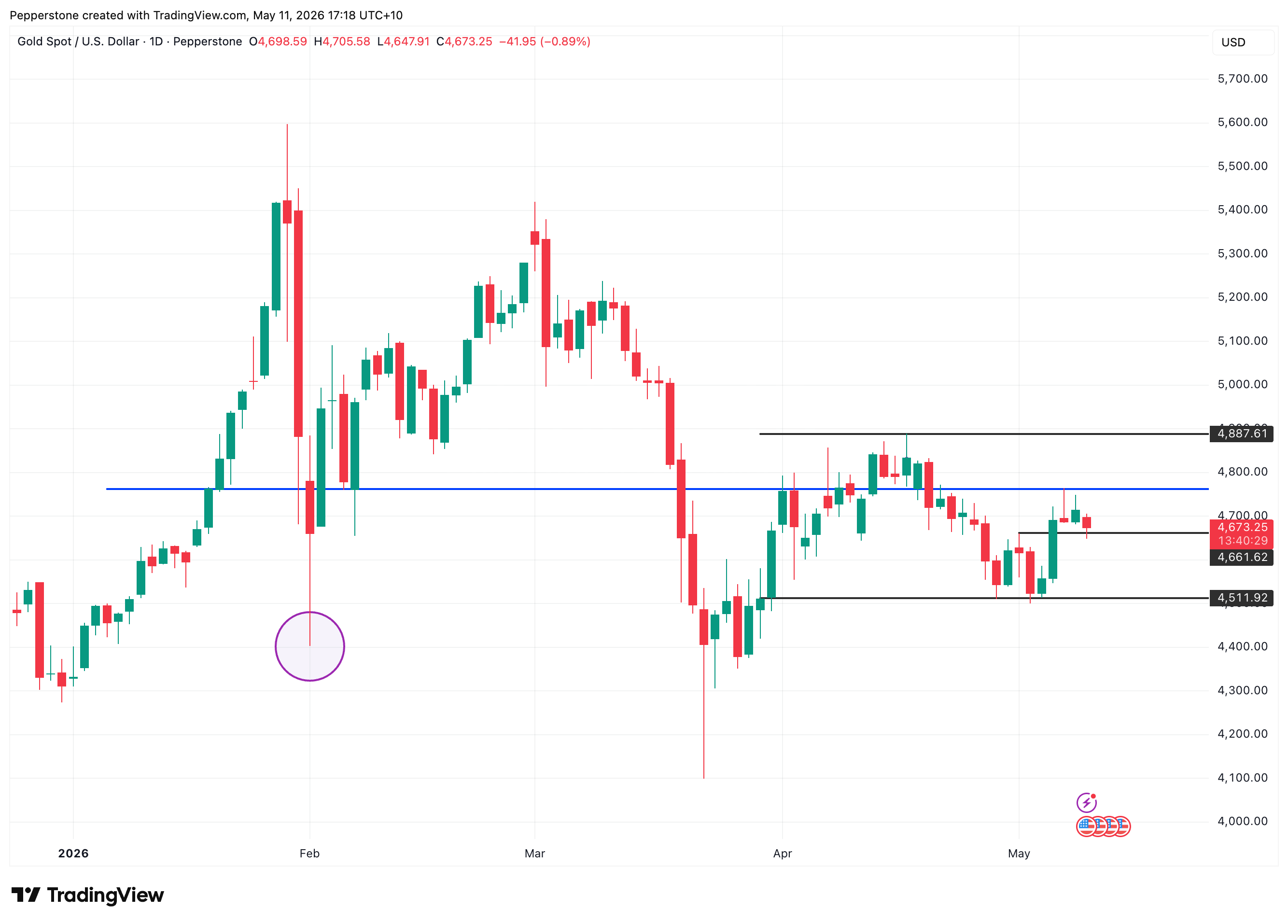
If gold can sustain a close above this level and push through last Wednesday's intraday high near $4,765 on solid volume, the recovery has room to extend — with bulls then targeting $4,800 and potentially the mid-April high around $4,890.
On the flip side, a decisive break below $4,660 would shift the near-term structure bearish, bringing the $4,600 area and the $4,500–$4,510 support zone back into focus as the next meaningful downside targets.
U.S.-Iran Talks Stall — Gold's Geopolitical Sensitivity Continues to Fade
The Middle East added another twist over the weekend. Reports indicated that last Wednesday, both sides had been negotiating around a 14-point memorandum of understanding covering a ceasefire, Strait of Hormuz transit rights, and limits on Iran's nuclear program, with Iran given 48 hours to respond on key terms. The prospect of diplomatic progress was enough to drive a sharp rally in gold on the day.
Then on Sunday, Trump declared Iran's latest response "totally unacceptable," while Israel emphasized that Tehran had made no substantive moves toward surrendering enriched uranium or dismantling nuclear facilities — casting a renewed shadow over the peace process and pushing oil prices higher.
For gold, which has exhibited a strong negative correlation with crude since the conflict began, rising oil prices — and the inflation expectations and rate constraints that come with them — translate into headwinds rather than support.
That said, gold's reaction to geopolitical headlines has clearly become more muted. Unless the situation deteriorates in a concrete way — a ceasefire breakdown or outright military escalation — the price impact is likely to remain sentiment-driven and short-lived.
Solid Payrolls Keep the Fed on Hold — But Cracks Beneath the Surface Offer a Floor
A second drag on gold came from the resilience of U.S. labor market data. April nonfarm payrolls came in at 115,000 — well above the 62,000 consensus — while wage growth edged in slightly below expectations and the unemployment rate held steady at 4.3%.
On the surface, this is a "still-resilient jobs market, contained wage pressure" combination that reinforces the Fed's case for holding rates where they are, creating a clear headwind for a non-yielding asset like gold.
But the details tell a more cautious story. Prior months were revised down by a combined 16,000 jobs, and when healthcare is stripped out, private-sector employment has been essentially flat for the past year — suggesting the underlying health of the labor market may not be as robust as the headline figure implies.
These signs of gradual cooling, combined with China's central bank extending its gold-buying streak to 18 consecutive months, provide a degree of fundamental support that limits how far gold can fall.
Gold Caught in the Middle — All Eyes on U.S. Inflation
Taken together, gold's consolidation over the past week reflects the push and pull between persistent Middle East uncertainty, a jobs report with hidden soft spots, and steady central bank demand. Absent a material escalation in geopolitical risk, the most likely near-term scenario is continued range-trading, with headline-driven moves amounting to short-term noise rather than the start of a new trend.
As attention shifts from geopolitics to fundamentals, inflation remains the Fed's primary concern — and gold's primary constraint.
Tuesday's April CPI release is the week's most important event. Markets are expecting headline inflation to rise to 3.7% year-over-year from 3.3% previously, with core CPI edging up to 2.7%.
If inflation comes in above expectations, it will cement market pricing for the Fed standing pat all year, supporting the dollar and Treasury yields while putting downward pressure on gold. A downside surprise, on the other hand, would chip away at tightening expectations and offer gold some modest relief.
Thursday's retail sales print adds another dimension. With the University of Michigan consumer sentiment index hitting consecutive record lows over the past two months, any sign of a meaningful pullback in consumer spending could reignite fears of a slowdown — or worse, a recession — and give gold's safe-haven bid a temporary lift.
The key this week, then, is not predicting which way gold moves, but watching how the data reshapes the market's understanding of where inflation is heading and what that means for Fed policy.
Related articles


The material provided here has not been prepared in accordance with legal requirements designed to promote the independence of investment research and as such is considered to be a marketing communication. Whilst it is not subject to any prohibition on dealing ahead of the dissemination of investment research we will not seek to take any advantage before providing it to our clients.
Pepperstone doesn’t represent that the material provided here is accurate, current or complete, and therefore shouldn’t be relied upon as such. The information, whether from a third party or not, isn’t to be considered as a recommendation; or an offer to buy or sell; or the solicitation of an offer to buy or sell any security, financial product or instrument; or to participate in any particular trading strategy. It does not take into account readers’ financial situation or investment objectives. We advise any readers of this content to seek their own advice. Without the approval of Pepperstone, reproduction or redistribution of this information isn’t permitted.