- English
- عربي


US Q226 Corporate Earnings: A trader’s guide to risk and opportunity


Key Takeaways
• Investor expectations are set high, with the S&P 500 companies forecast to deliver 12.3% year-on-year revenue growth.
• Technology (+34%) and energy (+27%) sectors are expected to lead revenue growth this quarter.
• The average S&P 500 stock moved 4.9% on earnings day last quarter, around three to five times what is typical for daily move.
• Earnings season presents both opportunity and risk, depending on a trader's timeframe and strategy.
• The biggest opportunities often emerge before earnings or after the market has fully digested the results, rather than the immediate reaction following the announcement.
• Pepperstone's 24-hour US Share CFDs allow traders to react through all sessions – for equity CFD traders, these can be effective instruments to consider.
High expectations set the stage for another volatile earnings season
Over the next four to five weeks, US-listed companies will report their quarterly earnings, giving investors an updated view on the health of the business, and guiding them to how they see future operating conditions.
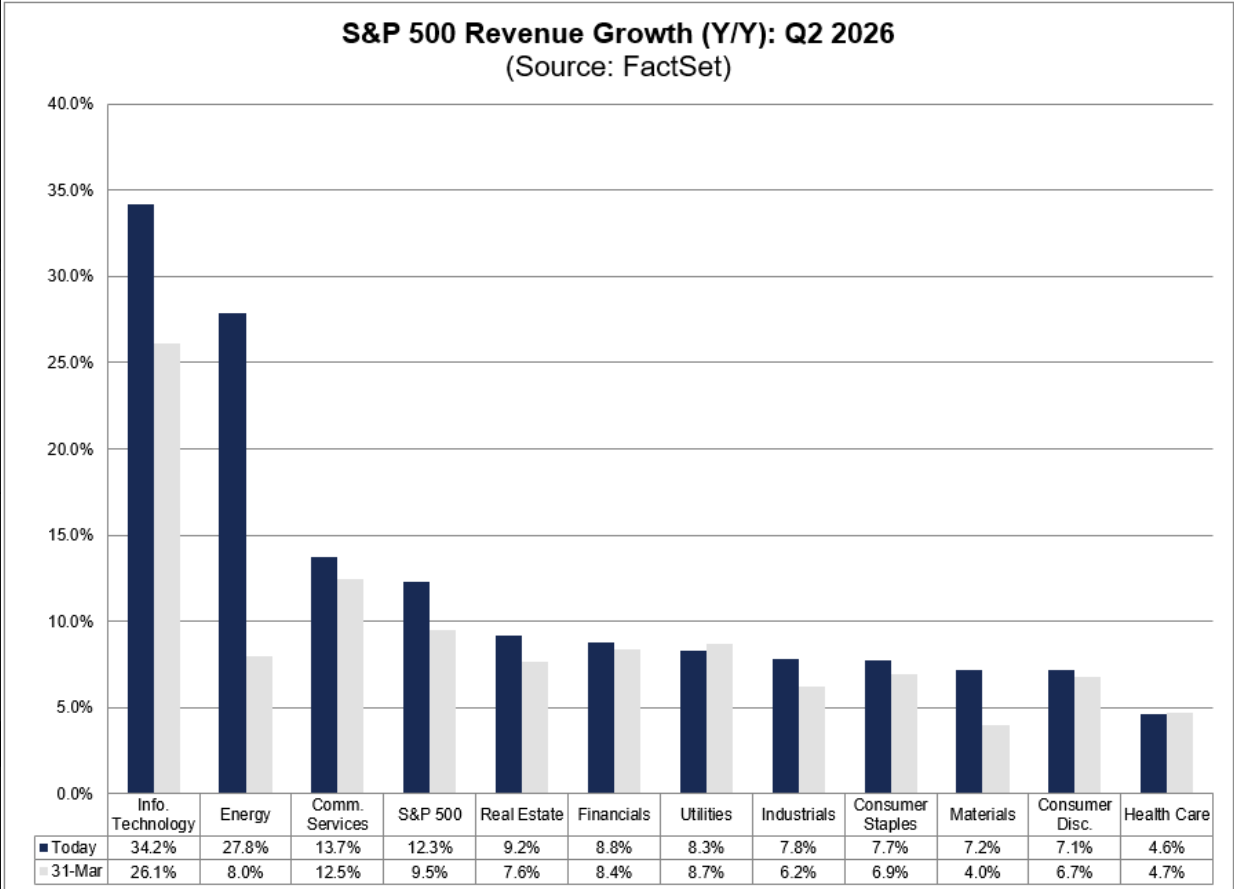
Current consensus expectations remain elevated. Aggregate S&P 500 revenue are forecast to grow by 12.3% year-on-year during the second quarter, with analysts steadily upgrading both earnings and revenue forecasts over recent months as stronger economic growth and improved business conditions have supported corporate profitability.
Technology is once again expected to dominate, with earnings forecast to grow by 34% year-on-year, while the energy sector is expected to deliver 27% growth. Those improving earnings expectations have been a significant driver behind the strong performance in both the S&P 500 and NASDAQ throughout the year.
Earnings season ultimately provides the market with an opportunity to marked-to-market expectations against reality. Investors reassess every assumption they have made about a company's outlook, profitability and future growth, and that process often results in substantial share price volatility.
Why earnings season creates so much volatility
For active traders, earnings season is unlike any other period of the year.
During the Q126 reporting season, the average S&P 500 company experienced an absolute move of 4.9% on its earnings day. That is roughly three to five times greater than the average move on a non-reporting day.
Four times each year, traders are forced to decide whether earnings represent an opportunity or simply a risk that needs to be managed.
There is no universal approach. Scalpers, day traders, swing traders and longer-term position traders all view earnings differently depending on their objectives, risk tolerance and investment horizon.
The first question every trader should ask is whether they want exposure over earnings at all.
For many, earnings simply represent an event risk that needs managing. That could involve reducing position size, closing a trade altogether, or accepting the volatility in the belief that the market will ultimately reward their longer-term investment thesis.
Others deliberately position ahead of earnings because they believe the market is mispricing the likely outcome.
Neither approach is inherently right or wrong. The key is understanding the risks involved.
The three stages of every earnings trade
Every earnings season can broadly be viewed through three distinct phases.
1. The first isthe period leading into earnings.
This is often where some of the easier trading opportunities emerge. If a company has rallied strongly into earnings, expectations become increasingly optimistic, positioning becomes crowded and the hurdle required to impress investors continues to rise.
In these situations, traders frequently reduce exposure ahead of results, locking in profits before the announcement. That positioning unwind can create meaningful price moves before the company has even reported.
2. The second phase involves the reaction when the earnings are announced
This is arguably the most difficult period to trade or get the desired fill.
When earnings hit the market, algorithms react within milliseconds. Modern trading systems instantly react to key words and numbers on revenue, earnings per share, margins, guidance and dozens of other metrics before discretionary traders have even finished reading the first headline.
At the same time, options positioning, dealer hedging flows and institutional order flow can amplify price movements, meaning the initial reaction isn't always logical.
Even if a trader correctly anticipated weaker earnings and positioned short, the share price may initially fall before rapidly reversing as positioning adjusts or investors focus on different aspects of the report.
Trading this period successfully requires far more than simply forecasting whether earnings will beat or miss expectations.
Professional hedge funds often combine earnings analysis with positioning data, options markets, institutional ownership and quantitative models before taking tactical positions around earnings announcements.
Why beating expectations isn't always enough
One of the biggest misconceptions during earnings season is that beating analyst forecasts automatically results in a higher share price.
Markets rarely work that way.
Nvidia provides an excellent example.
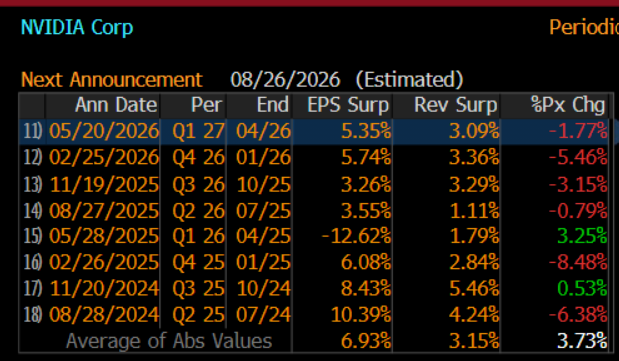
Across the past four quarterly reports, Nvidia has comfortably exceeded consensus expectations across earnings, revenue, margins, cash flow and forward guidance. In many cases it also exceeded the more demanding expectations held by institutional buy-side investors.
Yet despite those impressive results, the share price declined following each earnings release.
The explanation is straightforward.
Sometimes expectations become so elevated that even exceptional results fail to surprise investors.
Markets don't simply react to whether companies beat forecasts. They react to whether those results materially improve the existing investment narrative.
The best opportunities often come after earnings
Many of the highest conviction trading opportunities actually emerge after the initial volatility has subsided.
Consider a company operating within a strong structural theme, delivering consistent earnings growth and executing well operationally.
If the company reports solid results but fails to significantly exceed already lofty expectations, the share price may fall sharply despite nothing materially changing about the long-term investment case.
Those situations can present attractive opportunities.
Positioning has been cleaned out, overly optimistic expectations have been reset and yet the fundamental story remains intact.
Conversely, if management delivers genuinely new information that materially changes the long-term outlook, the initial market reaction is often only the beginning.
When the investment thesis fundamentally changes, the first move is frequently not the last, allowing trends to develop over subsequent days and weeks.
Consider Pepperstone’s US 24-hour CFDs during earnings season
Almost every US company reports either before the market opens or after the closing bell.
That means some of the biggest price moves occur outside regular trading hours.
Pepperstone's US 24-hour equity CFDs allow traders to participate during both pre-market and after-hours sessions, providing the flexibility to react before the broader market opens.
Whether traders choose to position ahead of earnings, respond immediately after the announcement, or wait for the market to fully digest the results, extended trading hours provide greater flexibility around some of the most significant events on the trading calendar.
US index CFDs also allow traders to express broader views on sectors or the overall market as earnings season unfolds.
What traders should watch first
The earnings season begins with the major US banks, offering valuable insight into credit demand, consumer activity, investment banking conditions and the overall health of the US economy.
Attention then quickly shifts towards the market's biggest drivers, including the mega-cap technology companies and AI leaders that continue to account for a significant share of index performance.
Given their index weightings, earnings from these companies can influence not only individual share prices but also broader movements in the S&P 500 and NASDAQ.
The bottom line
Every trader approaches earnings season differently, but the first decision is always the same: does earnings season represent a risk to be managed or an opportunity to be traded?
For some, the answer lies in reducing exposure before earnings. For others, the opportunity comes from identifying positioning extremes ahead of results or exploiting trends that develop once the market has fully assessed the numbers.
Whatever the approach, earnings season consistently produces some of the largest single-stock moves of the year. Understanding where those opportunities and risks are most likely to emerge can help traders navigate one of the busiest and most volatile periods on the market calendar.
Follow Pepperstone's earnings analysis throughout reporting season and keep US 24-hour US Share CFDs and US index CFDs on your radar as corporate America reveals its latest results.
The material provided here has not been prepared in accordance with legal requirements designed to promote the independence of investment research and as such is considered to be a marketing communication. Whilst it is not subject to any prohibition on dealing ahead of the dissemination of investment research we will not seek to take any advantage before providing it to our clients.
Pepperstone doesn’t represent that the material provided here is accurate, current or complete, and therefore shouldn’t be relied upon as such. The information, whether from a third party or not, isn’t to be considered as a recommendation; or an offer to buy or sell; or the solicitation of an offer to buy or sell any security, financial product or instrument; or to participate in any particular trading strategy. It does not take into account readers’ financial situation or investment objectives. We advise any readers of this content to seek their own advice. Without the approval of Pepperstone, reproduction or redistribution of this information isn’t permitted.